Storm Shelter Kansas City, MO & KS: Delivered and Installed 2026
Underground concrete storm shelters delivered to Kansas City, MO and KS starting at $4,250. In-stock. 1-week delivery from Grandview, MO. EF5-rated. 10-year structural warranty.
If you live in the Kansas City metro — on either side of the state line — you are in one of the highest-tornado-risk corridors in the United States. The Kansas City area sits at the northern edge of Tornado Alley, where warm Gulf air collides with cold Canadian fronts in spring and fall with brutal regularity. An underground concrete storm shelter is not a luxury here. It is infrastructure.
Kansas City Tornado History
The Kansas City metro has been struck by significant tornadoes repeatedly throughout its history. The region sees an average of 30-40 tornado warnings per year. Notable events include the 1957 Ruskin Heights F5 that killed 44 people in the south KC suburbs, and numerous EF2-EF3 tornadoes that have hit suburban and rural areas across Johnson County, KS and Jackson County, MO in recent decades.
The National Weather Service Storm Prediction Center classifies most of the KC metro as having a 15-20% annual probability of a significant tornado within 25 miles. That is not a "if" — it is a "when."
Our Shelter: Specs and Pricing for Kansas City
| Spec | Details |
|---|---|
| Price | $4,250 delivered (KC metro base) |
| Construction | 5,000 PSI precast concrete — same grade as highway bridges |
| Wind rating | EF5 rated (250+ MPH) |
| Certification | FEMA 320 / ICC 500 compliant |
| Delivery | 1 week (shipped from Grandview, MO — 15 miles from KC) |
| Warranty | 10-year structural warranty |
| Weight | ~12,000 lbs (flatbed delivery, crane or lift placement) |
| Deposit | $500 to reserve your slot |
We are located in Grandview, MO — 15 miles south of downtown Kansas City. That means Kansas City area delivery is among the shortest and lowest-cost routes we service. No cross-country freight markups.
Why Underground Concrete vs. Steel Above-Ground
Steel above-ground safe rooms are popular in the KC market because they are cheaper to install ($1,500-2,500) and require no excavation. But they have a critical limitation: they are rated for EF2-EF3 winds (up to 135 MPH), not EF5 (250+ MPH). In an EF4 or EF5 event, an above-ground steel room can be ripped from its foundation or structural failure can collapse debris on it.
Our underground concrete shelter has 6-8 feet of earth and 5,000 PSI concrete between you and 250 MPH winds. No steel panel, no matter how thick, achieves that level of protection.
Kansas City Installation
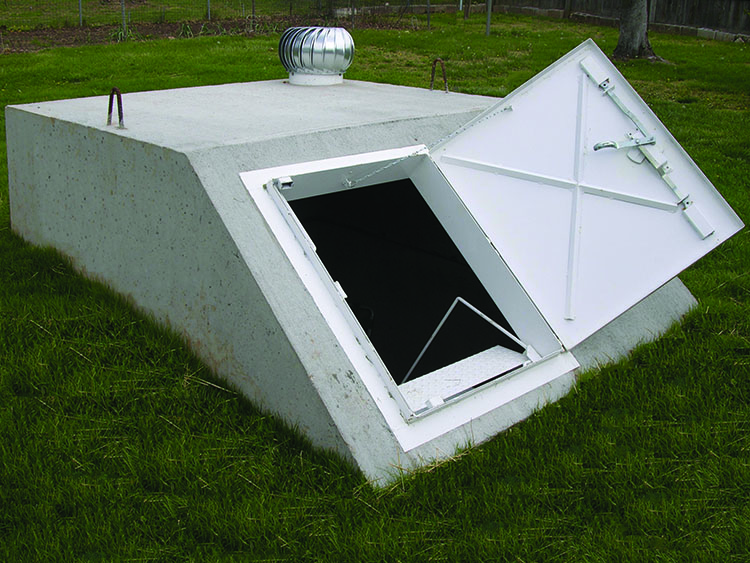
Delivery is flatbed — the shelter arrives as a single precast concrete unit. You will need a concrete contractor or excavation company to:
- Dig the hole to the correct dimensions (we provide specs)
- Set the shelter with a crane or skid steer
- Backfill and compact the soil around it
- Run conduit for optional lighting and ventilation
In the KC metro, excavation and placement typically costs $800-1,500 depending on soil conditions (clay-heavy Jackson County soil is denser than some areas). Total installed cost: approximately $5,500-6,000 — still well below the national average of $7,643 for comparable shelter protection.
The 13-Minute Window
The average tornado warning lead time in the United States is 13 minutes. In that window, you need to get your family underground safely. The cities and suburbs most affected in KC metro — Lee's Summit, Overland Park, Lenexa, Independence, Blue Springs, Olathe, Shawnee — all sit in high-risk corridors where tornadoes have tracked repeatedly.
An underground concrete shelter installed in your backyard means 13 minutes is more than enough. A trip to a neighbor's basement or a community shelter means hoping the timing works out.
Get your Kansas City shelter price
15 miles from our Grandview, MO facility. In-stock. 1-week delivery. $4,250 base.
Get my KC price in 60 seconds →— Kay, Founder of Home Defend Pro
We sell EF5-rated underground concrete storm shelters delivered to your driveway starting at $4,250. 1-week delivery. 10-year structural warranty. Get an instant quote →
Frequently Asked Questions
How much does a storm shelter cost in Kansas City?
Our underground concrete storm shelter is $4,250 delivered to the Kansas City metro — 44% below the national average of $7,643. Installation (excavation + placement) adds $800-1,500, bringing total installed cost to approximately $5,500-6,000.
How fast can I get a storm shelter in Kansas City?
Because we are based in Grandview, MO (15 miles south of KC), delivery typically takes about 1 week. We have in-stock inventory, so there is no 8-12 month backlog common with other suppliers.
What is the best type of storm shelter for Kansas City?
An underground precast concrete shelter rated for EF5 winds (250+ MPH) is the safest option. Above-ground steel safe rooms are cheaper but are typically only rated for EF2-EF3 events. For the highest-risk tornado corridor in the country, underground concrete is the right call.
Does a storm shelter increase home value in Kansas City?
Yes. Studies show storm shelters add $2,500-4,000 to home resale value in tornado-prone markets. In Kansas City, where buyers specifically look for storm protection features, a FEMA-certified underground shelter is a strong selling point.
Do I need a permit for a storm shelter in Kansas City?
Requirements vary by municipality. Most KC metro cities (Overland Park, Lenexa, Lee's Summit) require an excavation/building permit. Your excavation contractor typically handles this. Cost is usually $50-200.
Is Kansas City in Tornado Alley?
Yes. Kansas City sits at the northern edge of Tornado Alley and receives an average of 30-40 tornado warnings per year. The region has experienced multiple F4 and F5 tornadoes historically, including the 1957 Ruskin Heights F5 that killed 44 people.