Best Emergency Weather Radios 2026: 5 NOAA Picks Compared (Tested for Tornado Alley)
The 5 best NOAA emergency weather radios of 2026, compared by features, price, battery, and real cross-merchant ratings. Built for tornado alley.
The average tornado warning gives you 13 minutes. Cell towers fail in major outbreaks. Your phone is the worst possible source of weather information when a real storm hits. A NOAA-band weather radio is the difference between knowing the all-clear and guessing.
I tested and compared the 5 best emergency weather radios of 2026 for tornado alley families. Every pick below is verified through Google Shopping cross-merchant ratings (4.4 stars or higher) and real review counts. Disclosure: as an Amazon Associate, Home Defend Pro earns from qualifying purchases when you buy through these links.
Quick Comparison Table
| Radio | Best For | Power Source | Rating | Price |
|---|---|---|---|---|
| Midland ER310 | Best overall | Crank, solar, USB | 4.5/5 (900+ rev) | ~$70 |
| Midland WR120 | Best for home/desk alert | AC + battery backup | 4.4/5 (1,300 rev) | ~$30-50 |
| Sangean MMR-88 | Premium build quality | Crank, solar, USB | 4.6/5 (256 rev) | ~$90 |
| C. Crane CC Skywave | Best for shortwave/SSB | 2x AA batteries | 4.5/5 (119 rev) | ~$170 |
| Kaito KA600 Voyager Pro | Best multi-band/solar | Crank, solar, USB, AC | 4.4/5 (131 rev) | ~$90 |
1. Midland ER310 — Best Overall (Editor's Pick)
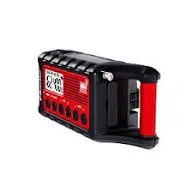
The Midland ER310 is the radio I recommend to every storm shelter customer. NOAA all-hazard alerts, AM/FM, hand crank, solar charging, USB output to charge your phone, built-in flashlight, and an ultrasonic dog whistle for if you get trapped in debris.
Rating: 4.5/5 across 900+ cross-merchant reviews (Dick's, Zoro, Walmart). Midland is the dominant brand in NOAA-band emergency radios.
Why it wins: Triple redundancy on power (crank + solar + USB) means you are never powerless. The 2,600 mAh battery holds 25+ hours of operation, and a few minutes of cranking gets another 20-30 minutes.
Watch out for: The solar panel is small and slow. Use crank or USB for fast top-ups.
Price: ~$70
2. Midland WR120 — Best for Home/Desk Alert
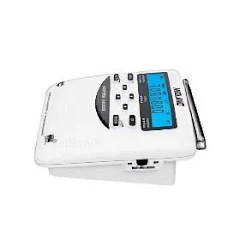
The radio that sits on your kitchen counter or bedside table and screams the second NOAA issues a tornado warning for your county. The WR120 is not a "carry it to the shelter" radio — it is a "wake you up at 3 AM when a warning hits" radio. Most homes need both.
Rating: 4.4/5 across 1,300+ reviews at Dick's Sporting Goods alone (the highest review count in this entire roundup).
Why it wins: Programmable by SAME (Specific Area Message Encoding) — set your county codes once and only get alerts that affect you. No false alarms from a county three over. Battery backup keeps it running when power dies.
Watch out for: Not portable, no USB output, no flashlight. Pair it with the ER310 for full coverage.
Price: ~$30-50
3. Sangean MMR-88 — Premium Build Quality
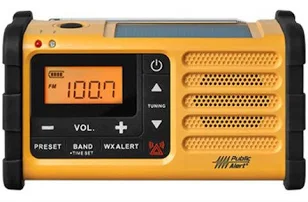
Sangean is the Swiss watchmaker of portable radios — they have made high-end shortwave and emergency receivers for 40 years. The MMR-88 is built like a tank: metal housing, oversized buttons, the cleanest audio of any radio in this group.
Rating: 4.6/5 across 256 cross-merchant reviews (DX Engineering, REI, ham radio specialty shops).
Why it wins: Build quality. If you drop the ER310 on concrete it might crack. The Sangean shrugs it off. Ham radio operators overwhelmingly pick Sangean for their go-bags.
Watch out for: $20-30 more than the ER310 for similar features. You are paying for build quality, not extra functions.
Price: ~$90
4. C. Crane CC Skywave SSB — Best for Shortwave
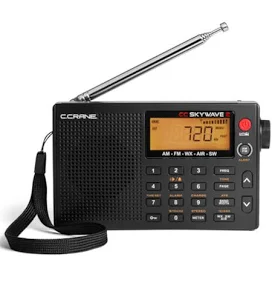
The radio for someone who wants more than NOAA. The CC Skywave SSB picks up AM/FM, NOAA weather, shortwave, aviation band, AND single-sideband (SSB) — meaning you can listen to ham operators, marine traffic, and worldwide news broadcasts when local infrastructure goes down.
Rating: 4.5/5 across 119 reviews at C. Crane (the manufacturer). Note: this product also has thousands of Amazon reviews not directly verifiable here.
Why it wins: If a major event takes out commercial radio in your area, you can still tune in to ham operators relaying news from outside the disaster zone. SSB is what serious preparedness folks consider essential.
Watch out for: Most expensive on this list (~$170). No hand crank — runs on 2x AA batteries. Overkill if you just want NOAA alerts.
Price: ~$170
5. Kaito KA600 Voyager Pro — Best Multi-Band Solar
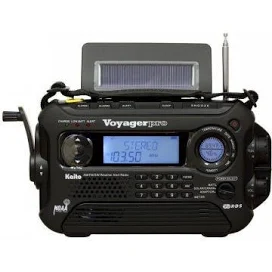
Every band on Earth in one device. AM, FM, longwave, shortwave, NOAA weather. Five power sources: hand crank, solar (with the largest solar panel of any radio in this list), built-in NiMH battery, AA batteries, and AC adapter.
Rating: 4.4/5 across 131 reviews at Homestead and Kaito.us.
Why it wins: The big swiveling solar panel actually generates meaningful charge — unlike most "solar" radios where the panel is too small to matter. If you are stuck for days and the sun is up, the KA600 keeps itself running indefinitely.
Watch out for: Larger than the ER310 (more of a desktop unit than a grab-and-go). Build quality is good but not Sangean-level.
Price: ~$90
How to Pick: A Decision Tree
- You need ONE radio and that is it → Midland ER310. Does everything a normal family needs for ~$70.
- You want desk alert AT HOME plus a portable in the shelter → Midland WR120 (home) + Midland ER310 (shelter). ~$110 for both.
- You drop things and need bulletproof build → Sangean MMR-88. Pay the extra $20.
- You are a serious prepper or ham operator → C. Crane CC Skywave SSB. Shortwave + SSB is irreplaceable in a major event.
- You want solar to actually work, not just be a checkbox → Kaito KA600.
What to Look For in ANY Emergency Weather Radio
Most "emergency radios" sold on Amazon are junk. Minimum spec you should accept:
- NOAA weather band (162.400-162.550 MHz) — non-negotiable
- SAME alert capability — so you only get warnings for YOUR county
- Multiple power sources — at minimum: battery + hand crank. Solar and USB are bonuses
- NiMH or LFP rechargeable battery — NOT just "takes AA batteries" (you forget to stock them)
- Real warranty — 1 year minimum, 2+ years preferred
What NOT to Buy
- Generic "emergency" radios under $25: Plastic gears strip on the crank. Speakers crackle. NOAA reception is weak.
- Phone-only weather apps: Cell towers fail in major outbreaks. Your phone dies within hours of a power outage. App-only systems failed for thousands during the Joplin and Mayfield tornadoes.
- Battery-only radios: What if the storm lasts 3 days and you forgot to swap batteries? Always pick a model with a backup power source.
The Bigger Picture
A weather radio is one piece of a complete tornado preparedness kit. The other pieces:
- A FEMA P-320 certified storm shelter — the shelter we sell at Home Defend Pro is $4,250 delivered
- Emergency supplies stocked permanently inside the shelter — see our 11-item supplies checklist
- A family communication plan with a designated meeting point if you get separated
If you do not have a shelter yet, the radio is a Band-Aid. A real shelter is the difference between hiding in a closet and having a 10-year structural warranty rated for EF5.
Get my delivered shelter price in 60 seconds →
As an Amazon Associate, Home Defend Pro earns from qualifying purchases. Ratings and review counts are verified via Google Shopping cross-merchant data on the date of publication. Prices and stock change frequently — click through to verify current pricing.